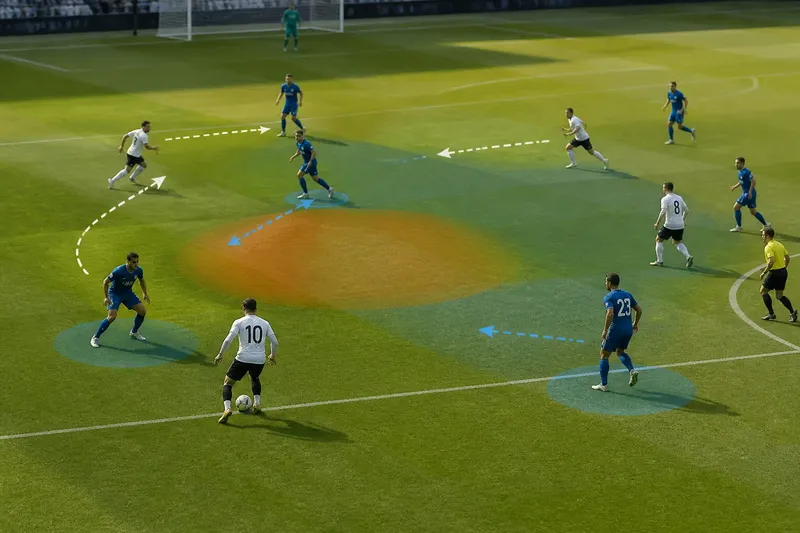
The Offside Line Is a Moment, Not a Place
Understand the offside line in soccer by checking the teammate’s touch, the attacker’s position, and whether later play makes that position an offence.
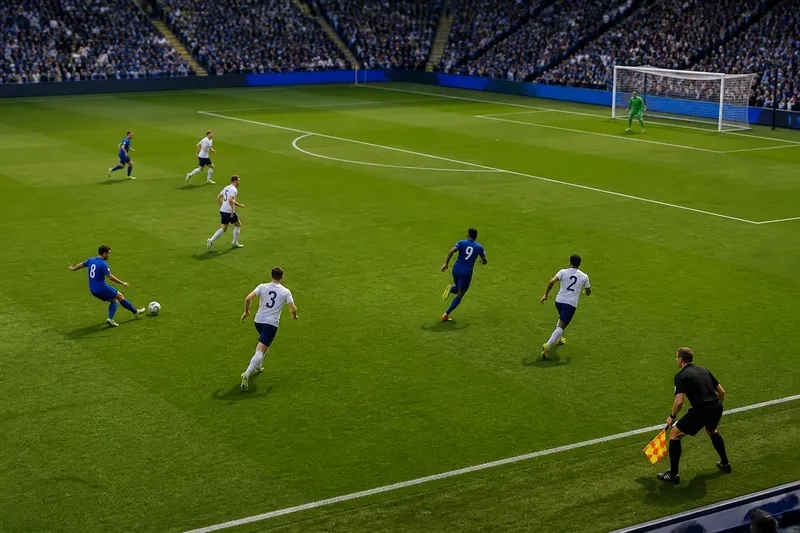
The offside line in soccer is judged at the instant a teammate plays or touches the ball, not where the attacker stands when the pass arrives. To read a close call, compare the attacker’s position with the ball and the second-last opponent at that touch, then watch what the attacker does next.
Find the decisive touch
For offside position, the relevant instant is when a teammate plays or touches the ball. The pass’s arrival, a defender’s later movement, and a broadcast line drawn across the field do not replace that moment.
At the touch, compare the attacker with the ball and the second-last opponent. An attacker is in an offside position only when in the opponents’ half and nearer the opponents’ goal line than both the ball and the second-last opponent. Being level with either one is onside.
The goalkeeper is not automatically the reference opponent. The rule looks at the second-last opponent, whoever that is at the relevant instant. The comparison uses body parts with which a player may legally play the ball; hands and arms are excluded.
Position is not an offence
Being in an offside position does not, by itself, stop play. The attacker must then become involved in active play under the rule, such as playing or touching the ball, interfering with an opponent, or gaining an advantage in specified circumstances.
Interfering with an opponent can include obstructing the opponent’s line of vision or challenging for the ball. Gaining an advantage can apply when an attacker plays the ball after it rebounds or deflects from an opponent, or after a deliberate save. Merely standing nearby is not automatically an offence.
Imagine a forward is beyond the second-last opponent when a teammate passes toward the penalty area. The forward stays clear of the defenders and lets the ball reach an onside teammate, who controls it. The forward’s position alone does not make the play offside; if the forward later obstructs an opponent or joins the play in another covered way, the decision can change.
How do rebounds and defender touches affect offside?
Does every deliberate defender touch reset offside?
No. A defender’s deliberate play can make an attacker’s earlier offside position irrelevant for a later involvement, but not every touch qualifies. The referee considers whether the defender had control and an opportunity to play the ball, including whether the action was a deliberate play rather than a deflection; the exact judgment depends on the circumstances.
Does a save reset the offside position?
No. A deliberate save by an opponent does not reset the comparison in the same way as a qualifying deliberate play. If an attacker in an offside position then plays the ball after that save, the attacker may be penalized for gaining an advantage.
What if a defender only deflects the ball?
A deflection does not make an attacker onside by itself. If the attacker was in an offside position when a teammate played the ball and then becomes involved after the deflection, the referee may penalize the attacker under the gaining-an-advantage provision.
Does a backward pass change the decision?
No. Judge the attacker’s position at the teammate’s touch, not by the direction the ball travels. A backward pass can still reach an attacker who was in an offside position at that instant, though an offence requires the later involvement specified by the rule.
Read a replay carefully
First identify the teammate’s touch that began the relevant play. Then compare the attacker with the ball and second-last opponent at that instant. A foot or head nearer the goal line can matter even if the shoulders look level, while hands and arms do not count.
A live assistant referee tracks the defensive line, but that line moves with the players. Video review may use synchronized images and calibrated lines to assess a close decision; the graphic is an aid, not the rule. A single broadcast angle may not show the exact timing or relative positions clearly.
Do not infer the decision from a flag or replay graphic alone when the view is blocked, delayed, or incomplete. The question remains whether the attacker was in an offside position at the relevant touch and then became involved in a way the rule covers.
What can viewers ignore?
It is not worth trying to memorize a permanent offside line for the whole attack or counting every defender between an attacker and the goal. The useful comparison is with the ball and second-last opponent at the teammate’s touch, and the attacker must also be in the opponents’ half.
For the offside line in soccer, keep the sequence simple: find the touch, compare positions, and watch for involvement. A close call may depend on timing or an angle the broadcast does not provide, but that does not change what the rule asks the referee to judge.