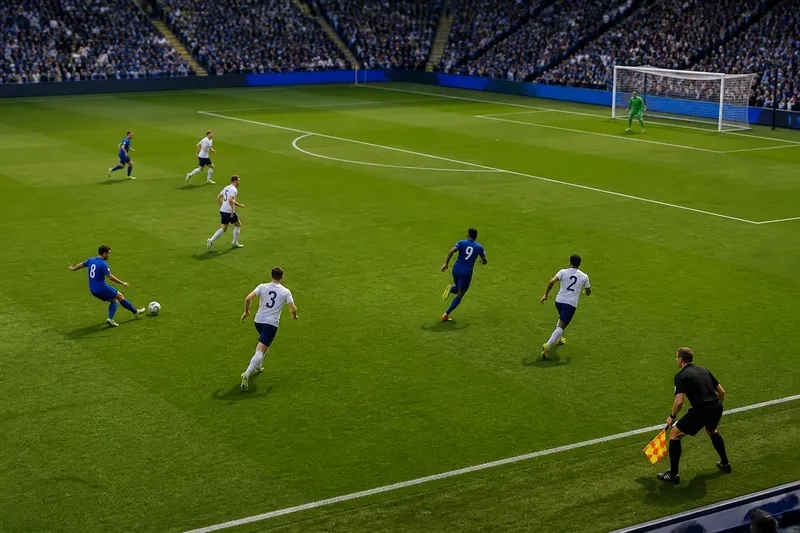
Man-to-Man or Zone: Two Ways to Defend Space
Man-to-man or zone defending becomes easier to read when you track each defender’s assignment, watch who takes over, and follow the space left open.
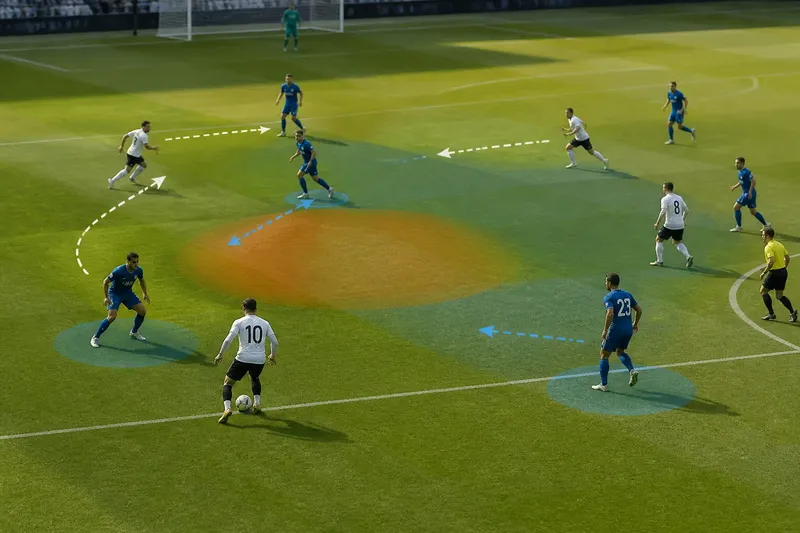
Man-to-man or zone defending changes what to watch before a pass is even made. In man-to-man coverage, a defender tracks an opponent; in zone coverage, a defender protects an area and reacts to whoever enters it. Both systems aim to limit useful attacks, but they ask defenders to notice different things—and leave different clues for viewers.
To read the choice during a match, start with one defender, then follow the attacker who approaches that defender’s patch of space. Watch what happens when the attacker moves away, when another opponent arrives, and when the ball changes sides. The pattern of handoffs and movement tells you more than a team’s starting formation alone.
Start with one pairing
Choose a defender and an opponent who is near the ball. If the defender keeps matching that opponent’s changes of direction, follows a run across the field, and stays close even when the ball moves elsewhere, the defender is likely using a man-oriented assignment. “Man-to-man” does not always mean a strict one-defender-to-one-attacker arrangement across the entire field. A team may apply close marking only in a particular area or phase.
Now watch the defender when the attacker leaves the immediate area. If the defender follows, the assignment is probably tied to the player. If the defender holds position and another defender takes over the runner, that is evidence of area-based coverage—or of a man-oriented system with a clear handoff rule. One movement cannot settle the question. Look for the same response on several attacks.
Use the ball as a reference point, not as the only thing to watch. A close defender may be tracking an opponent away from the ball, while a zone defender is already adjusting to protect the space that a pass could reach. The useful question is not simply “Who has the ball?” It is “Which defender is responsible for the next dangerous option?”
Read the assignment
Man-oriented defending asks a player to notice a particular opponent’s position, speed, and likely route. The defender must keep contact with that player while staying aware of the ball and the surrounding danger. A defender who watches only the assigned opponent can be pulled away from useful space. One who watches only the ball can lose the runner.
Area-based defending asks a player to notice a patch of space, the ball’s location, and the attackers entering that patch. The defender may shift toward a threat, close a passing lane, or pass an opponent to a teammate rather than follow them indefinitely. The assignment belongs more to the area than to one attacker, though teams still use individual matchups inside a zone.
To distinguish the systems, focus on decisions at the edge of an area. Does the defender keep following the same attacker as that player crosses into another part of the field? Or does the defender stop, communicate, and let a teammate pick up the runner? A clean transfer suggests shared responsibility. A defender who continues the chase may be operating under a player-focused instruction, or may be reacting to a specific threat.
Communication helps make those decisions visible. A defender may point, call for a teammate to take a runner, or shift a few steps to cover a gap. You do not need to hear the call to notice the response: watch whether the teammate accepts the runner and whether the first defender returns to a useful position.
Track the handoff
A handoff is one of the clearest moments to read. In a zone, an attacker who crosses from one defender’s area into another’s may be transferred between defenders. The first defender can then stay near the space they were protecting, while the next defender steps toward the attacker. That exchange is not a failure to mark. It can be the system working as intended.
In man-oriented coverage, the same crossing run can stretch the defense. The original defender may follow, drawing both players away from their starting positions, while teammates adjust to cover the resulting gaps. Some teams use switches to avoid chasing an opponent across the whole field; others accept the chase in selected situations. The label is useful, but the actual instruction matters more than a tidy category.
Try watching a runner who moves away from the ball. Does the defender stay with that runner, or does the defender release them to protect a lane? Then check the teammate nearest the destination. If that teammate takes over, the defense has shared the task. If no one does, the runner may have found a seam—or the defenders may simply have misread the movement.
Say you are watching an invented soccer match: a forward begins near the center, then drifts toward the left touchline while a teammate runs into the middle. If a central defender follows the forward all the way across, the middle can open for the second runner. If the defender holds the central area and a wide defender takes the drifting forward, the defense has shown a handoff. The observable result to watch is whether the central runner meets an unoccupied lane or finds a defender already waiting.
Follow the space left
Once you have a sense of the assignment, watch the space a defender leaves behind. Man-oriented coverage can open space when an attacker pulls a marker away from a valuable area. That movement may be deliberate: the attacker is acting as a decoy, or a teammate is timing a run into the space the marker vacated. The viewer can follow the defender’s movement and then check who tries to use the gap.
Zone coverage can leave space between areas or just beyond a line of defenders. An attack may try to move the ball quickly enough that defenders cannot shift together, or place an attacker between two defenders whose responsibilities are unclear. Watch for a player receiving the ball facing forward, rather than assuming every open patch is a mistake. A zone often allows less dangerous space in order to protect more dangerous space.
For a useful viewing angle, scan away from the ball just before it moves. In man-oriented coverage, look for a defender being drawn out by a run. In a zone, look for the defenders shifting as a group and for the next area the ball might reach. Then return to the ball and see whether the attacking team uses the space you noticed.
It is not worth trying to identify a whole defensive system from one still image or one isolated tackle. A team can change its approach by field position, score, opponent, or phase of play. A short sequence—movement, response, and the next pass—usually gives a clearer reading than a formation graphic.
Account for mixed systems
Many defenses combine player-focused and area-focused responsibilities. A team might press with close individual assignments near the ball, then retreat into a compact zone when the opponent escapes. It might defend a set piece with players assigned to particular opponents while teammates protect areas near the goal. A defender can also hold a zone but step out to challenge an attacker who receives there.
So treat “man-to-man” and “zone” as descriptions of the main responsibility, not permanent identities. Ask what the defenders are doing in the current situation. Are they following opponents, protecting lanes, or doing both? If a team changes its behavior after losing possession, that change may be a planned transition rather than inconsistency.
The sport and its rules also shape what the terms mean in practice. Basketball commonly makes individual matchups and zone alignments visible through player spacing; soccer often shows the distinction through tracking and handoffs; other sports have their own conventions. Where the correct interpretation depends on a league rule, coaching instruction, or competition format, check that source rather than assuming every sport uses the same definition.
What should you watch next?
Does man-to-man mean one defender follows one player everywhere?
Not necessarily. A coach may limit close marking to a zone, a particular opponent, or a specific phase, and defenders may switch assignments when teammates are better placed. Follow the defender’s behavior across several movements before deciding how strict the assignment is.
Can a zone still mark an individual attacker?
Yes. A defender may closely challenge an attacker who enters the protected area without following that player elsewhere. The distinction is whether the defender’s main responsibility stays with the player or with the space.
How can you spot a defensive handoff?
Watch one attacker cross from one defender’s area into another’s. If the first defender stops tracking and a teammate steps toward the runner, responsibility has likely been transferred. Check whether the first defender returns to cover nearby space rather than simply dropping out of the play.
Which system is better?
Neither is automatically better; the choice depends on the players, opponents, and match situation. For viewers, the more useful question is whether the defense is responding coherently: tracking, shifting, or handing over in ways that protect the intended space.
Make the next read
On the next attack, choose one defender and observe three things: who draws their attention, whether they follow or hold position, and what space opens after they act. Then check whether a teammate covers that space or takes over the runner. Repeating that small observation across a few possessions makes man-oriented assignments, zone shifts, and deliberate handoffs easier to separate.
Man-to-man or zone defending is easiest to understand as a question of responsibility: who owns the opponent, who owns the area, and who takes over when the two cross? Keep that question in mind and the space away from the ball becomes part of the match, not empty scenery.