Follow the Space Away from the Ball
Follow the space away from the ball to see how a team changes its shape, creates options and uses movement, even when the player you watch never receives a pass.
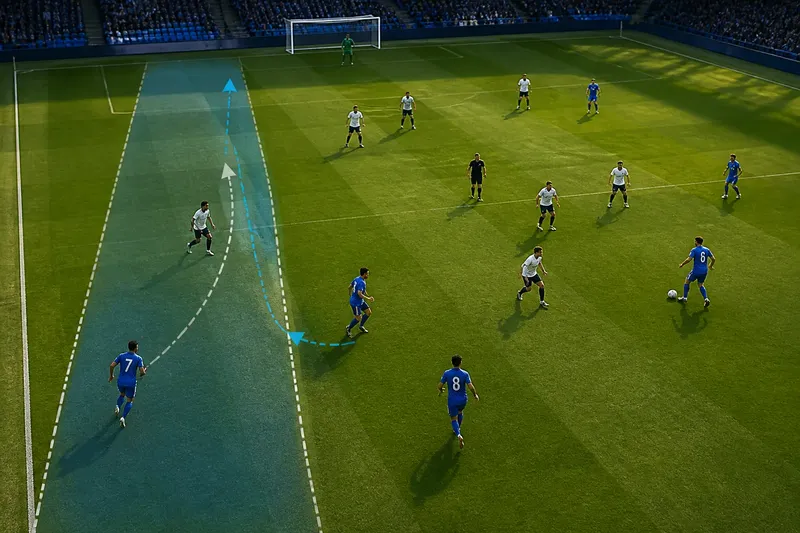
Follow the space away from the ball to see how a team changes its shape. Pick one patch of the field rather than one player, and watch how it is occupied, abandoned, or used as play develops.
Say you are watching an invented soccer match: the blue team has possession near the right side of midfield, while its left winger stands wide on the opposite flank. Instead of following the winger, keep your attention on the left-side channel between the touchline and the center of the field. Note who enters it, who leaves, and whether the ball eventually travels there.
Choose A Patch
Use a fixed landmark to keep the area clear in your mind: the far touchline, the space between two defenders, or the channel just outside the penalty area. A television broadcast may not show the whole field, so choose a patch that remains visible. At the stadium, a wide view makes this easier.
Watch the area for one attacking sequence, from controlled possession until a shot, turnover, clearance, or backward reset. You are not trying to track every player or identify a hidden plan. The useful record is simple: who occupied the patch, what changed, and whether it became useful to the team in possession.
If the camera cuts away, resume when the patch is visible again. Do not infer what happened outside the frame. Replays can clarify a change of shape, but pausing after every pass is more work than this exercise deserves.
Map The Occupants
Before the ball moves toward your chosen patch, note who is there. It might be empty, occupied by an attacker, or covered by a defender. Then notice the nearest route into it: a teammate could run in, a pass could arrive, or the team could shift the ball across the field.
In the invented match, the blue left winger begins in the wide channel while the ball is on the right. A blue midfielder is closer to the center, and the opposing right back is positioned between the winger and the goal. Those are visible facts. Whether the winger is trying to stretch the defense is an interpretation, so keep it separate from the map.
Look for overlap in the space. If two attackers move into the same narrow lane, one may block the other's route or make the area easier to defend. If nobody occupies it, that may leave room for a later run, but it does not mean a pass is available yet. Distance, pressure, and the angle of the ball all matter.
Track The Changes
Keep your gaze on the patch as the attack develops. A player may enter from the touchline, move out of the way, or hold a position that prevents a defender from stepping forward. The ball may approach, bypass the area, or never come near it.
In the invented sequence, the winger moves inward and the opposing right back shifts toward the center. A blue midfielder then runs into the outside channel the winger left. The patch has changed from occupied by one attacker to occupied by another. That shift is observable even without deciding why either player moved.
Now check the ball's route. It goes to the midfielder outside, who returns it under pressure rather than crossing. Blue switches play to the far side, and the attack ends without a shot. The channel helped provide an available outlet, but it did not lead directly to a chance. The sequence still gives you something concrete to read: the area changed occupants, received a pass, and then ceased to be part of the move.
Record What Changed
Separate the area's state from the match outcome. A completed pass does not automatically mean the space was useful, and a turnover does not erase a route that briefly opened. Ask what you could see, then note what happened next.
- Observation: The patch is empty, with a teammate close enough to enter. If the ball carrier has time and a clear angle, then watch for a pass or run into it; otherwise, note that the route is available but not yet usable.
- Observation: Two attackers occupy the same channel. If one moves out and the other remains, then note which route becomes clearer; otherwise, record that the overlap persists and look for a different lane.
- Observation: A defender steps into the patch as the ball approaches. If the passing route is blocked, then watch whether the team goes around or backward; otherwise, check whether the intended receiver can still reach the ball.
- Observation: An attacker leaves the patch and a teammate enters. If the teammate receives the ball, then note the change of occupant and the outcome; otherwise, record the switch without claiming it created a chance.
- Observation: The ball bypasses the patch while it remains open. If the attack later switches toward it, then see whether a player can receive there; otherwise, mark it as unused space for this sequence.
- Observation: The patch becomes crowded with opponents. If the ball carrier turns away, then follow the alternate route; otherwise, watch whether the pass gets through or is intercepted.
These decisions keep the exercise grounded in what the camera shows. You do not need to decide what the ball carrier ought to have done. A route may be visible to you and still be unusable from the player's position.
Why Does Space Matter?
What counts as open space?
Open space is an area without an opponent immediately occupying or closing it. It is only a possible route, not proof that a player can receive the ball there. The ball's angle, pressure, and the receiver's position determine whether the space is usable.
Should I follow the ball or the area?
For this exercise, stay with the area while play remains in view. Glance at the ball when needed to understand whether it is moving toward, away from, or past the patch. If the broadcast hides the area, wait for a wide view rather than guessing.
What if nothing happens there?
Record that the patch stayed unused or was closed by defenders. That is a valid result, not a failed viewing exercise. The contrast between an open area and the route the team actually chose can help explain the shape of the attack.
Does this work in other sports?
Yes, if you choose a stable area that players can enter or defend, such as a lane near the basket or a corridor between defenders. The dimensions and rules differ by sport, so describe what you can see rather than borrowing soccer terms for another game.
Work Through The Sequence
For the invented blue-team move, the starting inputs are the chosen outside channel, the winger already in that channel, a midfielder nearer the center, and the ball on the right. First, keep your view on the channel and note the winger's starting position. Next, observe the winger move inward as the ball advances. Then note the right back shifting toward the center and the midfielder entering the outside channel. Finally, check the ball's route: it reaches the midfielder, goes back under pressure, and is switched to the far side.
The resulting answer is limited but useful: the channel changed occupants and briefly served as an outlet; the attack then moved elsewhere and produced no shot. You can say that the area was used without claiming that it caused the switch or that the winger's movement was intended to produce it.
It is not worth drawing arrows over every frame or assigning a tactical motive to each player. A short note about the patch, its occupants, and the ball's route is enough to make a second viewing more legible.
On your next viewing spell, choose one patch and follow its changing occupants. The space away from the ball is not an empty diagram waiting for a perfect explanation; it is simply another part of the match you can observe, one change at a time.